Overview
Tongits (also spelled Tong-its) is the undisputed national rummy card game of the Philippines. Played by three players with a single standard 52-card deck, it combines classic rummy meld-building mechanics with tactical showdown calls, layoff plays called sapaw, and high-stakes risk management against getting burned (sunog).
In Cardems, you play against two sharp computer opponents in a three-player table setting. Every turn demands precision: should you expose melds to protect yourself from being burned, or keep your cards concealed to catch opponents off guard with a sudden Tongits declaration?
Objective
Win the round through one of three paths:
- Declare Tongits: Arrange every card in your hand into legal melds, or empty the hand through melds and layoffs.
- Call Draw & Win the Fight: Challenge the table to compare unmelded deadwood points and hold the lowest total.
- Stock Exhaustion: Hold the lowest eligible deadwood count when the final card is drawn from the center stock pile.
Setup
- A standard 52-card deck is used.
- Three players participate.
- The dealer receives 13 cards; the other two players receive 12 cards each.
- The remaining 15 cards form the face-down central stock pile.
- The dealer begins the game immediately by discarding one card face up to start the discard pile (no draw needed on the opening turn).
How to Play
Play moves clockwise around the table. Each turn consists of three distinct phases:
1. Draw Phase
You must begin your turn by acquiring a card in one of two ways:
- Draw from Stock: Take the top face-down card from the central stock pile into your hand.
- Chow (Take Discard): Take the top exposed card from the discard pile only if you can immediately combine it with at least two cards from your hand to lay down a brand-new legal meld onto the table.
2. Melding & Sapaw Phase
After drawing, you may optionally perform any of the following actions:
- Open Melds (Bahay): Place legal combinations face up on the table in front of you.
- Sets (Triplets / Groups): Three or four cards of the identical rank (e.g., 7♠-7♥-7♦).
- Runs (Sequences / Escaleras): Three or more consecutive cards of the same suit (e.g., 4♣-5♣-6♣). Aces are always low (A-2-3 is legal; K-A-2 is not).
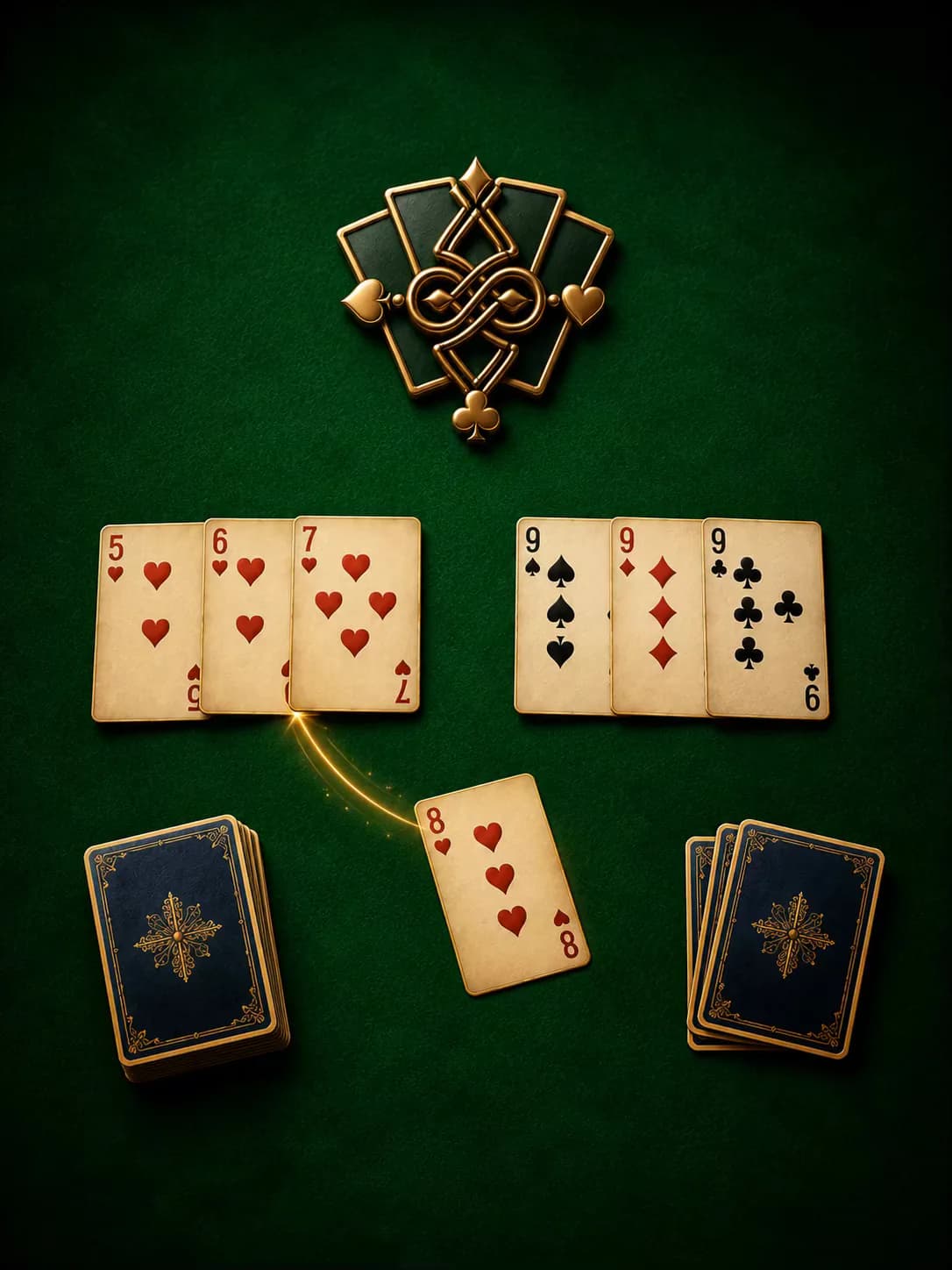
- Sapaw (Layoffs): Add one or more matching cards from your hand onto any existing open meld on the table—either your own or an opponent's meld.
- Example: If an opponent has an open 8♥-9♥-10♥ run on the table, you may play the 7♥ or J♥ from your hand onto their meld.
3. Discard Phase
Select one unwanted card from your hand and place it face up onto the discard pile to conclude your turn.
Calling Draw & The Fight
If you believe your unmelded hand has the lowest deadwood score, you can Call Draw at the start of your turn instead of drawing from the stock, provided you meet these eligibility requirements:
- You must have opened at least one meld on the table during the game.
- You must not be blocked by sapaw: You cannot call Draw if you added cards to your own melds on your previous turn, or if an opponent performed sapaw on your melds since your last turn.
- No opponent has declared Tongits.
Ending the Game & Scoring
1. Declaring Tongits
If you are able to meld all cards in your hand (either by laying down new melds or performing sapaw on existing table melds) so that zero cards remain in your hand, you immediately declare Tongits and win the round unconditionally.
2. Stock Exhaustion & The Sunog (Burned) Penalty
If all 15 cards in the stock pile are drawn and no player has called Draw or declared Tongits:
- All players reveal their remaining unmelded cards.
- Sunog (Burned) Rule: Any player who failed to open at least one meld on the table during the game is declared Burned (Sunog) and cannot win the stock-exhaustion comparison, regardless of how little deadwood they hold.
- Among the unburned (eligible) players, the player with the lowest deadwood total wins.
- If nobody has opened a meld when the stock ends, the round has no eligible winner.
Deadwood Card Values
| Card Rank | Deadwood Point Value |
|---|---|
| Ace (A) | 1 point |
| 2 through 10 | Face value (2 to 10 points) |
| Jack, Queen, King (J, Q, K) | 10 points each |
Strategy
- Use Sapaw defensively: Performing sapaw on an opponent's open meld burns their ability to call Draw on their next turn, giving you breathing room to improve your hand.
- Dump high-value face cards: Kings, Queens, and Jacks are worth 10 deadwood points each. Discard unmelded face cards early to minimize your point exposure.
- Watch the discard pile: Track which suits and ranks your opponents chow to avoid feeding them crucial cards.
- Compare with other international rummy games like Conquian, Chinchón, and Buraco.
FAQ
What does "Sapaw" mean in Tongits?
Sapaw is the act of laying off a card from your hand onto an already opened meld on the table (either your own or an opponent's).
What happens if I am "Sunog" (Burned)?
A player who has not opened a meld is considered burned at stock exhaustion and cannot win that comparison. Only opponents who have opened a meld are eligible to challenge a Draw call.
Can Aces be high in a run?
No. In Tongits, the Ace is strictly low. It can only be used in A-2-3 sequences or in three/four-of-a-kind sets of Aces.
Who wins if there is a tie during a Draw fight?
If the player who called Draw ties with an opponent who challenged the call, the challenger wins. The caller must hold a strictly lower score than all opponents to win the Draw.