Overview
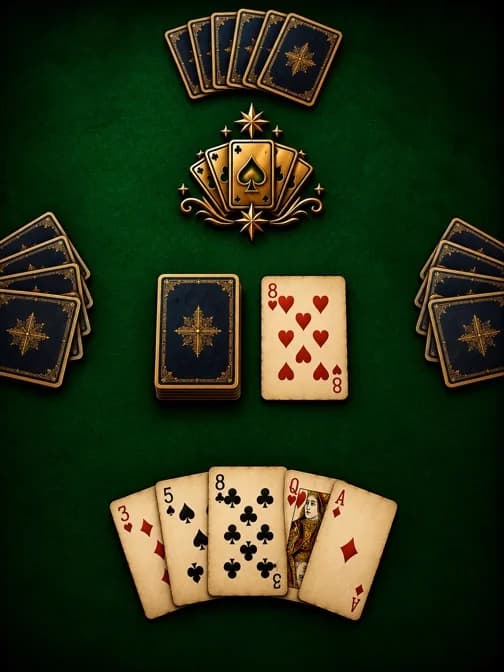
Pusoy Dos (often referred to as Filipino Poker or the Philippine edition of Big Two) is a fast, highly competitive four-player shedding and climbing card game. Every player receives 13 cards, and the goal is straightforward: be the first player to empty your hand by playing singles, pairs, triples, or five-card combinations that beat the current play on the table.
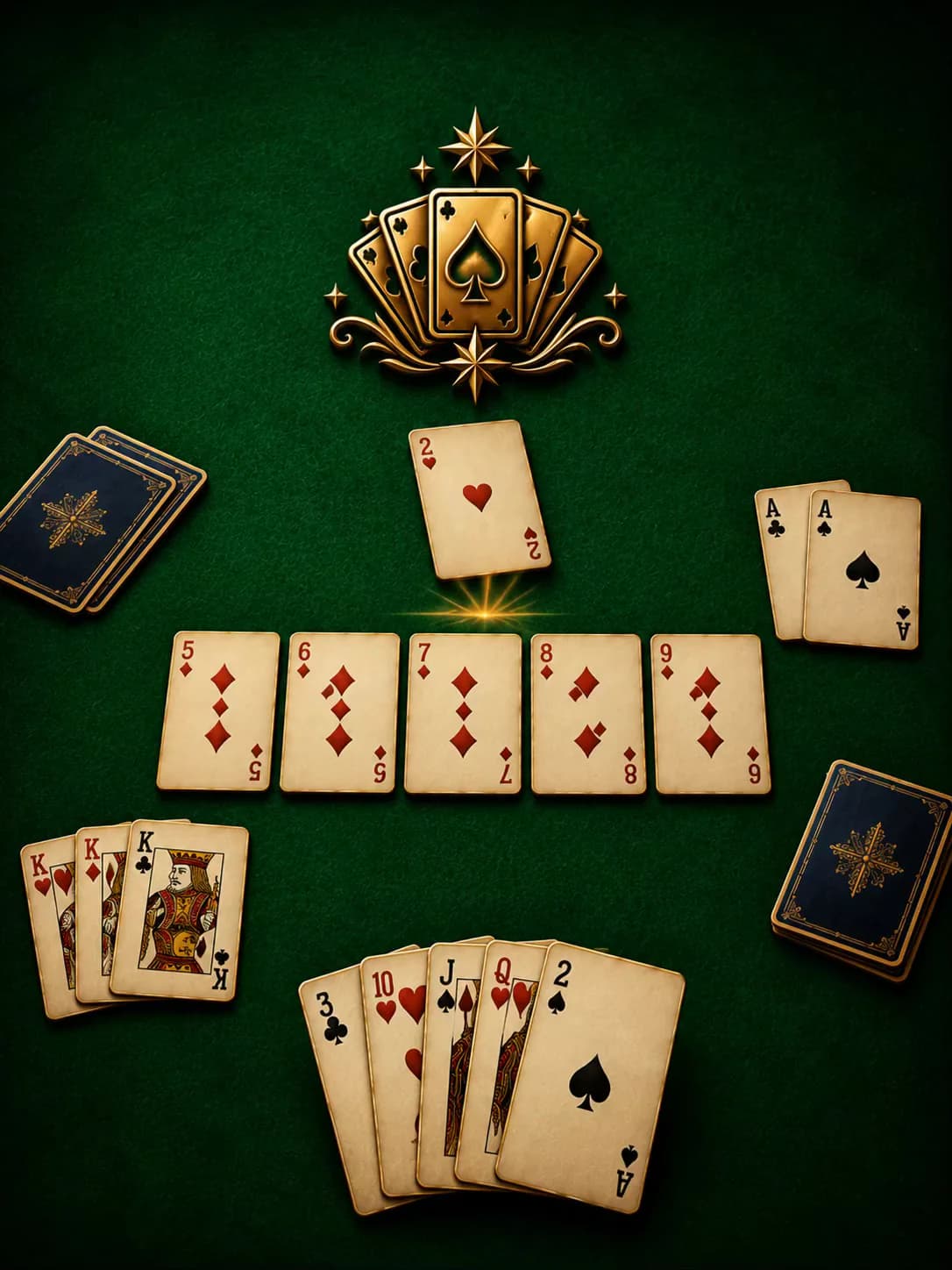
In Cardems, you play against three computer opponents. The game tests your ability to manage combinations, hold powerful high cards (the legendary 2♦), and seize control of the lead.
Objective
Be the first player to shed all 13 cards from your hand. When a player goes out, the hand concludes immediately and all opponents receive penalty points for the cards remaining in their hands.
Setup & Card Rankings
A standard 52-card deck is dealt equally among 4 players (13 cards each).
Card Rank Hierarchy
Pusoy Dos features a unique rank order where 3 is the lowest rank and 2 is the highest rank:
3 < 4 < 5 < 6 < 7 < 8 < 9 < 10 < J < Q < K < A < 2
Suit Rank Hierarchy
When cards share the same numerical rank, suits break ties in the following order (from lowest to highest):
Clubs (♣) < Spades (♠) < Hearts (♥) < Diamonds (♦)
How to Play
The Opening Lead
- The player holding the 3♣ must open the first round.
- The opening play may be a single card, a pair, a triple, or a 5-card combination, but it must include the 3♣.
Climbing the Table
Play proceeds clockwise around the table. Each player must either:
- Beat the current play by playing a higher combination of the exact same card count (e.g., a single beats a single, a pair beats a pair, a 5-card hand beats a 5-card hand).
- Pass: If you cannot or choose not to beat the current play, you may pass.
Winning Control
When three consecutive players pass, the table is cleared. The last player who played a valid card or combination gains control (the lead) and may lead any new single, pair, triple, or 5-card combination of their choice.
Legal Combinations
Players may only play combinations with 1, 2, 3, or 5 cards (there are no 4-card standalone plays):
| Combination | Description | Tie-Breaking Rules |
|---|---|---|
| Single | Any single card | Higher rank wins; if identical rank, higher suit wins |
| Pair | Two cards of identical rank | Higher rank wins; if identical rank, highest suit in the pair wins |
| Triple | Three cards of identical rank | Higher rank wins |
| 5-Card Hand | A traditional 5-card poker combination | Evaluated by category and that category's tie-break rules |
Five-Card Hierarchy
When answering a 5-card lead, any higher 5-card category beats any lower category regardless of rank:
- Straight: Five consecutive ranks (e.g., 8-9-10-J-Q). Ranked by highest card in the sequence, then suit of the highest card.
- Flush: Five cards of the same suit. Ranked by suit first, then by the highest card within the flush.
- Full House: Three of a kind plus a pair. Ranked by the rank of the triple.
- Four of a Kind (+ 1 Kicker): Four identical ranks plus any single card. Ranked by the rank of the four matching cards.
- Straight Flush: Five consecutive ranks sharing the same suit. The strongest possible 5-card combination.
Cardems also recognizes the two wrapping straights A-2-3-4-5 and 2-3-4-5-6. In this ruleset they rank above 10-J-Q-K-A, with 2-3-4-5-6 the strongest straight pattern.
Scoring and Winning
A match consists of several deals and ends when any player's cumulative penalty reaches 30 points:
- When a player sheds their final card, they win the deal with 0 penalty points.
- Opponents score 1 penalty point per card remaining in their hand.
- Holding 10–12 cards doubles the penalty.
- Being caught with all 13 cards gives a fixed 39-point penalty.
As soon as any total reaches 30 or more, the player with the fewest cumulative penalty points wins the match. Ties are broken by hands won, then by the table's stable seat order.
Strategy
- Preserve your 2s for control: A high 2 (especially 2♦ or 2♥) guarantees you can take control of the table and lead the combinations that clear out your weak cards.
- Break unhelpful groups for 5-card hands: Look for opportunities to combine singleton high cards into Straights or Flushes rather than letting them linger as vulnerable singles.
- Track the four 2s and Aces: Knowing which 2s have been played tells you when your highest remaining card has become unbeatable.
- Explore related shedding and social games like President rules and Vändtia.
FAQ
Is Pusoy the same as Pusoy Dos?
No. In the Philippines, Pusoy usually means a Chinese Poker game: each player arranges 13 cards into a three-card front hand and two five-card hands, and the hands are compared row by row against the other players. Pusoy Dos is the shedding game on this page, where you play combinations onto the table to empty your hand first. They share the 13-card deal and poker hand rankings, but are played very differently.
Can I play Four of a Kind by itself?
No. In Pusoy Dos, Four of a Kind must be played as a 5-card combination accompanied by a 5th card (kicker).
Which suit is the highest in Pusoy Dos?
Diamonds (♦) is the highest suit, followed by Hearts (♥), Spades (♠), and Clubs (♣). This differs from Western Poker rankings where Spades is often high.
What is the lowest card in the game?
The 3 of Clubs (3♣) is the lowest card. The player holding 3♣ must play it on the opening trick of the first deal.
If I pass, can I play later in the same trick?
Yes. Passing does not eliminate you from the current trick. If opponents continue playing and the action returns to you, you may play if you can beat the new high combination.